
About Migraines
MIGRAINES EXPLAINED
Migraines are a unique neurological disorder:
that causes a variety of symptoms, most notably a throbbing, pulsing headache on one side of your head. Not every headache is a migraine. There are many causes for a headache as it can be a symptom of other diseases. Migraine is classified as a “primary headache”. This means that the headache is not caused by another underlying medical condition. A secondary headache is a symptom of another health issue like anaemia, infection, stress etc.
About 12% of the population suffers from migraines.
Migraines can begin at any age, though the first attack often occurs during adolescence. Migraines tend to peak during your 30s, and gradually become less severe and less frequent in the following decades. Migraine prevalence decreases with age. Women are three times more likely than men to have migraines.
The diagnosis of migraine is clinical and made by excluding other underlying causes.
There are no laboratory and no radiological tests to diagnose migraine. The diagnosis of migraine can sometimes be difficult because secondary headaches can co-exist with migraine and the fact that the symptoms may overlap with other neurological disorders. Symptoms of migraine for one patient may also change between attacks.

Migraine is under diagnosed and under treated worldwide. 40% of people living with migraine disease are undiagnosed by a healthcare provider.
Migraine is often hereditary. Many people with migraine have other family members who suffer from migraine. If both parents suffer from migraine, then there is a 75% chance their children will also have migraine; when only one parent experiences migraine, there is a 50% chance the child will develop migraine. If a distant relative has migraine headaches, a 20% chance exists that any offspring will be prone to migraine headaches.
Migraine is a major public health problem. Worldwide about 1 billion people suffer from migraine. It’s the leading cause of disability for people under 50. The socioeconomic impact of migraine through treatment and loss of productivity is considerable. Absenteeism from work occurs more often in people with migraine. “Presenteeism” is also more common for those with migraine. Presenteeism is when employees work while sick. They just kind of slug through their day because they must be there. Productivity obviously suffers as a result.
The biology of migraine is complex and mostly unsolved.
Current theory suggests that migraines are triggered from within the brain itself. Once an attack begins, the pain and other symptoms of migraine arise from an inflammatory process resulting from an interaction between the trigeminal nerve and blood vessels in the coverings of the brain. Serotonin, a naturally occurring chemical in the brain, has been implicated in this inflammatory process


“A migraine? Really? Can’t you just take something and come in?”
About one-third of people with migraine experience migraine stigma. Stigma can make people with migraine feel invalidated or discouraged, and it can even cause people to doubt their experiences or believe they are overreacting to their symptoms. One of the most obvious causes for stigma about migraine is that it is an invisible illness. Many people who don’t suffer from migraine believe that the mild and tolerable headaches they experience are the same as migraine. Only in the last 30 years has migraine been treated as a neurological brain disorder, rather than a psychosomatic condition.
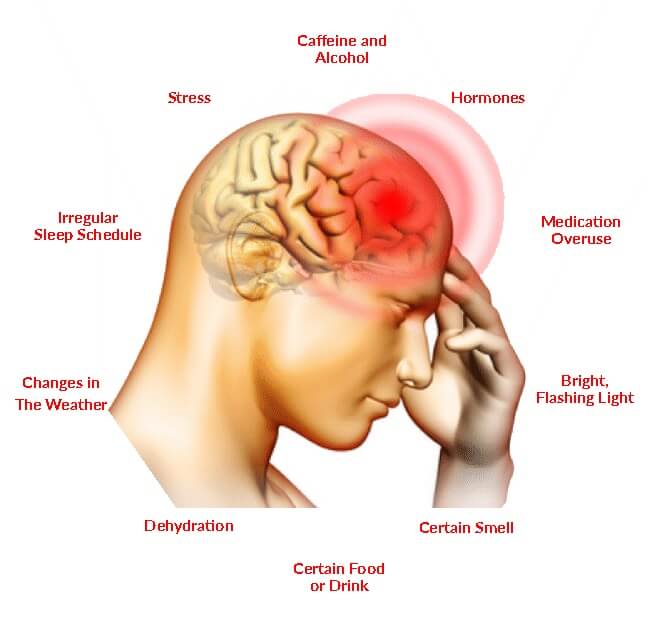
Migraine triggers are specific factors that may induce a migraine attack in people who are prone to the condition.
A certain trigger will not induce a migraine in every person; and, in a single migraine sufferer, a trigger may not cause a migraine every time. Everyone has different triggers, but there are a few common culprits that affect many people living with migraine:
- Stress: Stress is a trigger for almost 70% of people with migraine.
- Missing sleep or getting too much.
- Hormones: Women are three times more likely to have migraine than men, and up to 75% of women experience “menstrual migraine,” due to the change in oestrogen and progesterone levels. Pregnancy, ovulation, and hormonal medications, such as oral contraceptives, also can worsen migraines.
- Changes in the weather: Storms, excessive heat and changes in barometric pressure.
- Diet: The list of foods known to trigger a migraine attack is very long. Commonly reported migraine triggers to include alcohol (especially red wine and beer), chocolate, aged cheese, cured meats, smoked fish, yeast extract, food preservatives that contain nitrates and nitrites, artificial sweeteners, and monosodium glutamate (MSG) and anything with a strong smell.
- Dehydration: About 1/3 of people with migraine say dehydration is a trigger. Sometimes an attack can be stopped in its tracks by simply drinking a glass of water.
- Light: Both natural, bright light and fluorescent or flickering bulbs can be triggers.
- Smell: Perfumes, strong food smells, chemicals, or gasoline.
- Medication Overuse: If you take acute pain medication for more than 10 days out of a month, it can in itself cause more migraine attacks—a phenomenon known as Medication Overuse Headache (MOH).
DIAGNOSTIC CRITERIA FOR MIGRAINES
Migraine is divided into two major sub-types:
Migraine is divided into two major sub-types:
- Migraine without aura (common migraine)
- Migraine with aura (classic migraine)
- Migraine without aura is the most common type (75%)
To diagnose migraine doctors, use specific clinical criteria.
The International Headache Society (IHS) formulated the following criteria for this type of migraine:
View IHS Article HERE
At least 5 attacks of headaches:
- lasting between 4-72 hours
- the headache has at least two of the following characteristics:
- one side of the head (left or right)
- pulsating in nature (throbbing)
- moderate to severe pain
- during the headache at least one of the following:
- nausea and/or vomiting
- photophobia (sensitivity to light) and phonophobia (sensitivity to noise).

- Migraine with aura less common (25%)
The headache is the same as for common migraine except that the headache is now preceded by an “aura”. Auras consist of focal neurologic symptoms. Examples of an aura:
- Flashes of light or zigzag lines or even visual
- Tingling or numbness, sometimes beginning on one side of the face or hand and slowly expanding to encompass an entire side of the body.
- Smelling things that aren’t there.
- Muscle weakness on one side of the body.
- Speech difficulties.
Aura symptoms typically develop slowly, over 5 to 20 minutes, and do not last more than 60 minutes.
When one of the features needed to fulfil all criteria for Migraine is missing your headache might be labelled as “Probable migraine”.
Call Us Today
011 865 3148
073 027 0242